TEDx WWF - Jason Clay: Biogas Digesters in Africa

TEDx WWF - Jason Clay: Biogas Digesters in Africa

The distribution of household biogas digesters in Africa could reduce green house gas emissions and violence against women and children, increase life expectancy, food security and literacy, and offset carbon emissions from China.

Biogas plant design Calculator

Biogas plant design

This Calculator can be used for biogas plant sizing. This calculation provides an idea about Biogas Plant Sizing

 Link

Animation of a telescoping biogas digester

Animation of a simple telescoping biogas digester

this simple animation describing just how simple it is to build your own biogas digester I downloaded Google Sketchup 7 and then used Google 3D Warehouse to download a model of a digester by roilbilad130 called "Biogas untuk limbah dapur" which is Indonesian for "Biogas for Kitchen Garbage". I changed the food inlet pipe and the fertilizer output pipe to reflect the way they work in the ARTI India systems we have been building in Cairo and Germany and set different sequence animation key frames in Sketchup and did screen capture in Snap Z Pro. Building real digester is about as easy as building a digital one in sketchup -- it really is just two plastic barrels, one inverted inside the other, with three pipes -- one to get the food in, one to take the liquid fertilizer out and one at the top to deliver the gas to your cookstove or generator. 1000 liter tanks should get you about 2 hours of cooking gas a day if you live in a warm climate. As shown, we intend to use psychrophilic bacteria at the bottom to increase cold weather production. The process is very simple -- on the first day you put in about 40 kg of animal manure (horse or cow work fastest, but anything will work) and fill up the container with water. Then place the gas collector on top with the valve open so it sinks down into the bottom container, driving out the air. Then close the valve. After about 3 weeks the gas being created inside the container will be flammable. From that point on you start adding ..

biogas digester pdf

  1. TECHNOLOGIES DEMONSTRATED AT ECHO: HORIZONTAL ...

    www.wcasfmra.org/biogas.../Horizonal%20Biogas%20Digester.pdf
    File Format: PDF/Adobe Acrobat - Quick View
    by C FORST - 2002 - Cited by 2 - Related articles
    Copyright ©2002. ECHO, 17391 Durrance Rd., North Ft. Myers FL 33917, USA. Phone: (239) 543-3246; Fax: (239) 543-5317 e-mail: echo@echonet.org; ...
  2. [PDF] 

    TECHNOLOGIES DEMONSTRATED AT ECHO: FLOATING DRUM ...

    www.wcasfmra.org/biogas.../Small%20Scale%20Biogas%20Plans.pdf
    File Format: PDF/Adobe Acrobat
    Copyright© 2001. ECHO, 17391 Durrance Rd., North Ft. Myers FL 33917, USA. Phone: (239) 543-3246; Fax: (239) 543-5317 e-mail: echo@echonet.org; ...
  3. [PDF] 

    LOW-COST PLASTIC BIOGAS DIGESTER IN INTEGRATED ...

    www.wcasfmra.org/biogas.../...
    File Format: PDF/Adobe Acrobat - Quick View
    LOW-COST PLASTIC BIOGAS. DIGESTER IN INTEGRATED. FARMING SYSTEMS IN VIETNAM. Vo Lam,. Takeshi Watanabe,. Tran Thi Phan & Ly Thi Lien Khai ...
  4. [PDF] 

    Oil Drum Biogas Digester with optional gas storage (Courtesy of ...

    www.wcasfmra.org/biogas.../...
    File Format: PDF/Adobe Acrobat - Quick View
    Page 1. Oil Drum Biogas Digester with optional gas storage (Courtesy of E.G. Matthews)

PDF bio-gas

  1. CHAPTER 4 Construction Manual of Bio-gas Reactor

    www.apo-tokyo.org/gp/e_publi/biogas/BiogasGP4.pdf
    File Format: PDF/Adobe Acrobat - Quick View
    46. CHAPTER 4. Construction Manual of Bio-gas Reactor. 4.1 Planning. Criteria for Bio-gas Plant Construction. Family size. 4.1.1 Farmer who wants to build a ...
  2. [PDF] 

    CHAPTER 7 Operation Manual of Bio-gas Reactor

    www.apo-tokyo.org/gp/e_publi/biogas/BiogasGP7rev.pdf
    File Format: PDF/Adobe Acrobat - Quick View
    91. CHAPTER 7. Operation Manual of Bio-gas Reactor. 7.1 The Significance of the Bio-gas. Bio-gas is a form of energy produced when organic materials such ...
  3. [PDF] 

    Bio-gas: GP Option for Community ... - Asian Productivity Organization

    www.apo-tokyo.org/gp/e_publi/biogas/BiogasGP3.pdf
    File Format: PDF/Adobe Acrobat - Quick View
    37. CHAPTER 3. Review Of Bio-Gas Technology. 3.1 Bio-Gas Technology. Bio-gas technology is the transformation of solid waste through anaerobic digestion ...
  4. [PDF] 

    Bio-gas: GP Option for Community Development - Asian Productivity ...

    www.apo-tokyo.org/gp/e_publi/biogas/BiogasGP2.pdf
    File Format: PDF/Adobe Acrobat - Quick View
    16. CHAPTER 2. An Overview of Green Productivity for Community Development. 2.1 Introduction. As mentioned in the previous chapter, GP is also applicable to ...

PDF Biogas Plant

  1. Design of Biogas plant

    www.lged-rein.org/.../publications_Design%20Biogas%20Plant.pdf
    File Format: PDF/Adobe Acrobat - Quick View
    Preparing this training material all the important information have been collected from the booklets & research materials of Biogas Training Center (BRC) ...
  2. [PDF] 

    IMPLEMENTATION OF HOUSEHOLD BIOGAS PLANT BY NGOS IN ...

    www.inseda.org/.../Lessons%20learnt%20NGOs%20Biogas%20progr...
    File Format: PDF/Adobe Acrobat - Quick View
    IMPLEMENTATION OF HOUSEHOLD BIOGAS PLANT BY NGOS IN INDIA-. PRACTICAL EXPERIENCE IN IMPLEMENTATION HOUSEHOLD BIOGAS ...
  3. [PDF] 

    Empowering rural poor women by enhancing income through ...

    www.inseda.org/.../...
    File Format: PDF/Adobe Acrobat - Quick View
    EMPOWERING RURAL POOR WOMEN BY ENHANCING INCOME THROUGH BIOGAS PLANT. BY INSEDA AND WAFD IN BHARTAPUR, INDIA. By. Raymond ...
  4. [PDF] 

    Penkun: World's largest Biogas Plant goes online

    www.envitec-biogas.com/.../en/EnviTecForumBiogasSpezial1En.pdf
    File Format: PDF/Adobe Acrobat - Quick View
    Interview with Dr. B. Schramm,. Chairman of the Board of. NAWARO BioEnergie AG: Dr. Schramm, in Penkun the largest biogas plant of the world is being built. ...

Design of Biogas plant pdf

  1. Design of Biogas plant

    www.lged-rein.org/.../publications_Design%20Biogas%20Plant.pdf
    File Format: PDF/Adobe Acrobat - Quick View
    Preparing this training material all the important information have been collected from the booklets & research materials of Biogas Training Center (BRC) ...
  2. [PDF] 

    Design and Field Testing of a Compact Biogas Plant

    www.vrac.iastate.edu/ethos/ethos05/.../karvedesignfieldtesting.pdf
    File Format: PDF/Adobe Acrobat - Quick View
    Design and Field Testing of a Compact Biogas Plant. A.D. Karve1, Gandhali Kulkarni2,. Priyadarshini Karve1,2. 1Appropriate Rural Technology Institute (ARTI), ...
  3. [PDF] 

    Design of Biogas Plant from Fruit Market Waste in Indonesia

    www.ppiswedia.se/.../...
    File Format: PDF/Adobe Acrobat - Quick View
    by K Cahyari - 2010 - Related articles
    Renews 2010 –Renewable Energy Conference, Berlin, Germany. 12 - 13 October 2010. 1. Design of Biogas Plant from Fruit Market Waste in. Indonesia ...
  4. [PDF] 

    Model based design of an agricultural biogas plant – application of ...

    www.araconsult.at/download/literature/agricultural_biogas_plant.pdf
    File Format: PDF/Adobe Acrobat - Quick View
    by B Wett - Cited by 8 - Related articles
    1. 7th INTERNATIONAL SYMPOSIUM ON. WASTE MANAGEMENT PROBLEMS IN AGRO-INDUSTRIES. Amsterdam, 27-29 September, 2006. TURKISH ...
  5. [PDF] 

    Mission Report on Design Selection of Domestic Biogas Plant for the ...

    www.snvworld.org/.../Mission_report_on_design_selection_of_dome...
    File Format: PDF/Adobe Acrobat - Quick View
    Mission Report on Design Selection of Domestic. Biogas Plant for the Uganda Domestic Biogas. Programme. Prepared by: Peter Bos, Biogas Advisor SNV ...
  6. [PDF] 

    Design of Biogas Plant for Rural Households in Uganda (Case ...

    mak.ac.ug/documents/Makfiles/aet2011/Otim%20(2).pdf
    File Format: PDF/Adobe Acrobat - Quick View
    Second International Conference on Advances in Engineering and Technology. Design of Biogas Plant for Rural Households in Uganda (Case Study: ...
  7. [PDF] 

    Design of a Biogas Plant for Electricity and Heat Production at a ...

    www.ltu.se/.../...
    File Format: PDF/Adobe Acrobat - Quick View
    Design of a Biogas Plant for Electricity and Heat Production at a Large Dairy Farm in Juoksengi future in order to achieve a sustainable energy system for ...
  8. biogas plant design - Download PDF Free - PDF files and E-book ...

    www.downloadpdffree.com/biogas-plant-design.pdf
    Download Free PDF.com provides tons of ebooks in PDF format. PDF books can be downloaded for free.
  9. Biogas PDF Downloads BIOGAS PLANT DESIGN CONSTRUCTION MANUAL

    www.currentversionplugingoogleupdate.org/.../www__matchmaking...
    Biogas PDF Downloads BIOGAS PLANT DESIGN CONSTRUCTION MANUAL. Home made biogas ( Methane ) Gobar gas Generator You can make biogas energy with a DIY methane ...
  10. biogas plant design download pdf | Download Free biogas plant ...

    www.lexiguru.com/.../biogas-plant-design-download.pd... - United States
    Results 1 - 10 of 171 – “faperta.ugm.ac.id/newbie/download/pak_tar/agrobiot... 2.56 MB 23-Mar-2010. Recent advances in engineering plant tolerance to abiotic ...
  11. biogas plant design pdf | Download Free biogas plant design Ebook

    www.lexiguru.com/search/biogas-plant-design.pdf - United States
    Results 1 - 10 of 171 – “Recent advances in engineering plant tolerance to abiotic stress ... 190.74 KB 13-Jul-2006. SYMBIOSIS VERSUS COMPETITION IN PLANT ...

biogas plant manual filetype pdf

  1. Biogas Plant Construction Manual

    https://ronna-afghan.harmonieweb.org/.../2011-04-27_Afghan_Biog...
    File Format: PDF/Adobe Acrobat - Quick View
    27 Apr 2011 – Biogas Plant Construction Manual. Fixed-dome Digester: 4 to 20 Cubic Meters. United States Forces – Afghanistan, Joint Engineer Directorate ...
  2. [PDF] 

    3-CUBIC METER BIOGAS PLANT A CONSTRUCTION MANUAL a VITA ...

    www.small-farm-permaculture-and-sustainable-living.com/.../methan...
    File Format: PDF/Adobe Acrobat - Quick View
    3-CUBIC METER BIOGAS PLANT. A CONSTRUCTION MANUAL a VITA publication. ISBN 0-86619-069-4. [C] 1980 Volunteers in Technical Assistance ...
  3. [PDF] 

    Nepal Biogas Plant -- Construction Manual

    www.jatropha.pro/.../Biogas-Construction-Manual.pdf
    File Format: PDF/Adobe Acrobat - Quick View
    Nepal Biogas Plant -- Construction Manual. Construction Manual for GGC 2047 Model Biogas Plant. Biogas Support Programme (BSP). P.O. Box No. ...
  4. biogas plant design manual - Download PDF Free - PDF files and E ...

    www.downloadpdffree.com/biogas-plant-design-manual.pdf
    Download Free PDF.com provides tons of ebooks in PDF format. PDF books can be downloaded for free.
  5. Biogas PDF Downloads BIOGAS PLANT DESIGN CONSTRUCTION MANUAL

    www.currentversionplugingoogleupdate.org/.../www__matchmaking...
    Biogas PDF Downloads BIOGAS PLANT DESIGN CONSTRUCTION MANUAL. Home made biogas ( Methane ) Gobar gas Generator You can make biogas energy with a DIY methane ...

Biogas 100 PDF E-Books

  1. BIOGAS TECHNOLOGY – EXPERIENCE OF PCRET

    www.pcret.gov.pk/files/Experience.pdf
    File Format: PDF/Adobe Acrobat - Quick View
    Biogas plants could be broadly classified into three types: ... PCRET has installed all the three types of biogas plants on experimental basis in a quest of ...
  2. [PDF] 

    Biogas Support Program is a Reason for its Success in Pakistan

    idosi.org/aejsr/1(1)06/9.pdf
    File Format: PDF/Adobe Acrobat - Quick View
    by SZ Ilyas - 2006 - Cited by 2 - Related articles
    biogas technology is one of the reliable renewable energy sources used for ... Biogas technology has proved to be very successful in the country since it not only ...
  3. [PDF] 

    Activity Report-Biogas Project

    fidapk.org/programs/reports_assets/AR-Biogas%20Project.pdf
    File Format: PDF/Adobe Acrobat - Quick View
    Winrock International, presented the concept of up-scaling biogas across Pakistan at the household level based on the model being implemented in Nepal for ...
  4. [PDF] 

    Biogas - Sulabh International Social Service Organization

    www.sulabhinternational.org/downloads/Biogas.pdf
    File Format: PDF/Adobe Acrobat - Quick View
    Multi-. Purpose. Use of. Biogas. (From Human Excreta). SULABH INTERNATIONAL. SOCIAL SERVICE ORGANISATION. Sulabh Gram, Mahavir Enclave ...

Search Result Biogas From www.paksc.org

  1. All about biogas plant in pakistan

    www.paksc.org/pk/how-to-make/bioenergy/biogas-plant.html
    Biogas In Pakistan, Pakistan has low forest cover. About 4% of total area is covered by forest, in which only 5% area is protected. 90% of country's wood ...
  2. Biogas, an answer to Pakistan's energy crisis | Pakistan Science ...

    blog.paksc.org/2011/11/18/biogas-answer-pakistan’s-energy-crisis/
    18 Nov 2011 – Pakistan is spending almost 20 per cent of its foreign exchange on fossil fuels imports. Annually $7 billion is being eaten away in import of ...
  3. Biogas | Pakistan's First Science Blog

    blog.paksc.org/tag/biogas/
    Share Biogas, an answer to Pakistan's energy crisis Pakistan is spending almost 20 per cent of its foreign exchange on fossil fuels imports. Annually $7 billion is ...
  4. Benefits of biogas | Pakistan Science Club Blog

    blog.paksc.org/2011/10/31/benefits-biogas/
    31 Oct 2011 – Benefits of biogas are to be found in improved health and sanitation, workload reduction, increased agricultural production, reduced use of ...

Biogas can meet 20pc energy needs


Pakistan is spending almost 20 per cent of its foreign exchange on fossil fuels imports while annually $7 billion is being eaten away in import of conventional energy resources that is equivalent to 40 per cent of total imports by the country, but the country still lacks far behind in tapping the vast potential of alternate energy resources.
A research conducted by the University of Agriculture, Faisalabad, suggests that the country’s energy demand is expected to increase threefold by 2050, but supply position is not inspiring in anyway. It also indicates that Pakistan has almost 3,000 MW power generation potential in sugar industry through biogas, but it is hardly producing some 700MW.
The study estimates that Pakistan has almost 159 million animals that produce almost 652 million kilograms of manure daily from cattle and buffalo only, which can be used to generate 16.3 million-cubic-meters biogas per day and 21 million tons of bio fertilizer per year.
Pakistan can also explore biogas potential of citrus pulp, paper industry, slaughter house and street waste. It indicates that poultry waste is ideal substrate to produce biogas.

Government of Khyber Pakhtunkhwa introduces the latest bio gas technology in province

Government of Khyber Pakhtunkhwa introduces the latest bio gas technology in province – SIDB has LUMCHED a new project of Biogas Plants in Province
Peshawar: The provincial government of Khyber Pakhtunkhwa introduces the latest bio gas technology in province, for this purpose Small industries development board SIDB has LUMCHED A NEW PROJECT OF BIOGAS PLANTS IN PROVINCE.
THE bio gas project funded by Pakistan Italian DEBIT swap agreement biogas originates from biogas material and is a type of bio fuel, which primarily comprises of methane and carbon dioxide.
Biogas can be used as a low- cost fuel for heating cooking power generation.
The gas also becomes pressed, much like natural gas used to power motor vehicles.
Being a renewable source of energy. biogas qualifies for renewable energy subsidies in some parts of the world
According to the spokesman of SIDB NAUMAN Qaiser , biogas technology can benefit the country in economic , social and environmental sectors.
The technology can play a vital role in overcoming problems of energy sectors both domestic and commercial and is successfully in operation in various parts of the country .
He said that Pakistan did try bio-gas production in the seventies but in could not succeed due to lack of states of the art technology and awareness among the communities .
The SIDB under Dr. Akhter hussain shah Managing Director , for the first time would work on government level in the history of province through private partnership.
The board would set up at least 436 small and medium biogas plants developed at house hold level in Peshawar , Abbottabad Charsada Manshera Haripur and Nowshera districts.
Small and medium scale domestic biogas plant cost no more than Rs. 50 thousand to one and half lack even in the courtyard of rural houses.
It can generate 3-7 cubic meter of natural 50 to 75 percent methane, the major source of energy that burs instantly and produces heat .
The gas could also be used to produce electricity by using common petrol generators with little alteration the facility will also help reduce expenditure on fuel production . transformation distribution and generate jobs by creating micro small and medium scale enterprises .
For more information, contact:
Government of Khyber Pakhtunkhwa
Tel: +9291 921 6889 (Ext 106)
Email: info@khyberpakhtunkhwa.gov.pk

BIOGAS PROJECT Photos

With the help and expertise of the German Toilet Organisation, we're building a biogas system for the new Pestalozzi Children's Village. This will allow us to capture methane gas from the villages waste to reuse for cooking, and will enable us to treat all of our wastewater, which will be reused for agriculture. Very exciting!!!

https://picasaweb.google.com/jeannette.laramee/BIOGASPROJECT

BIOGAS PROJECT Photos from picasa


Rural areas start to tap huge biogas potential

Rural areas start to tap huge biogas potential

Rural areas start to tap huge biogas potential
biogas plant in Pakistan
A plethora of biogas plants are springing up around Pakistan as the country strives to become more energy self-sufficient and bring power to its poor, rural communities.
The Small Industries Development Board (SIDB) in Pakistan is one organisation that has realised the potential biogas has to offer developing nations struggling to bring energy to all.
It has launched a new project to roll out at least 400 small and medium biogas plants developed at household level in Peshawar, Abbottabad, Charsadda, Mansehra, Haripur and Nowshera districts, under the management of its director, Dr Syed Akhter Hussain Shah.
The biogas projects were funded by a Pakistan Italian Debt SWAP agreement. According to the spokesman of SIDB, Noman Qasir, biogas can benefit the country in economic, social and environmental sectors. He said that Pakistan did try biogas production in the Seventies, but it did not succeed due to lack of state-of-the-art technology and awareness among communities.
Elswehere, BETA PAK and the Pakistan Dairy Development Company (PDDC) are working through joint ventures in biogas technology development for domestic uses in Pakistan. The MOU has not only helped in identifying and jointly implementing various biogas projects across the country, but has also facilitated private sector biogas technology development by BETA PAK. Under this arrangement the domestic biogas plants already developed by PDDC are being jointly operated and maintained, while developing hundreds of other biogas plants all over the country.
BETA PAK has also signed a MOU with Human Appeal International to develop biogas technology for domestic uses in Khyber Pakhtunkhawa, AJK and Margalla National Park in the Islamabad Capital Territory. So far twenty biogas plants have been completed and handed over to the communities in Samani in, District Bhimber, AJK, while ten domestic have been completed in the Buffer Zone of the Margala National Park in the Islamabad. With a view to bring the mushrooming poultry sector into the biogas net, a domestic biogas plant using poultry waste has also been completed in Mansehra.
BETA PAK and the Punjab Disaster Management Authority are also working to develop a total of 450 domestic biogas plants. Out of this target, work on initially developing 116 plants in the model villages in the disaster affected districts of Liah, Bhakar and Mianwali were nearing completion in September 2011.
3 GW biogas potential
Research conducted by the University of Agriculture in Faisalabad suggests that Pakistan’s sugar industry alone could generate close to 3,000 MW of power through biogas, but is currently hardly producing 700 MW. The study concludes that biogas is the best substitute to conventional fuels.
It also estimates that Pakistan has almost 159 million animals producing approximately 652 million kilogrammes of manure daily from cattle and buffalo alone, which can be used to generate 16.3 million-cubic-metres of biogas per day and 21 million tonnes of bio fertiliser per year.
Economic and social benefits
Highlighting the economic and social benefits of biogas generation, the research indicates that a biogas unit of 10-cubic-metres could save around Rs92,062 per annum. To do so, the report’s authors say, Pakistan shoud learn from the European Union, where countries must produce at least 22.1 per cent of their electricity from renewable resources by 2020.
By following the same rules, they say, Pakistan could ensure nearly 70 per cent of the country’s rural population could benefit from biogas energy. Research discloses that demand for small biogas power generation units is increasing steadily as this decentralised source of energy can ensure uninterrupted power supply to villages.
Roll-out of 10,000 units in 5 years
The study also recommends that the country could explore using citrus pulp, waste from the paper industry, slaughter house and street waste to generate biogas. The Pakistan government launched the Biogas Support Program (BSP) in 2000, which has achieved a target of installing some 1,200 biogas units around the country, while the projects described above are contributing to ensure an additional 10,000 units are rolled out over the next five years, tapping almost 27 per cent of the country’s biogas potential.
[Photo: Courtesy of Biogas Plant Design blog]
For additional information:
Biogas Support Program

Source:  http://www.renewableenergymagazine.comhttp://www.renewableenergymagazine.com/energias/renovables/index/pag/biogas/colleft//colright/biogas/tip/articulo/pagid/17979/botid/76/title/Pakistan%20starts%20to%20tap%20its%20huge%20biogas%20potential/

SIDB launches biogas plants project in Khyber Pakhtunkhwa

SIDB launches biogas plants project in Khyber Pakhtunkhwa

Business Recorder Logo The Small Industries Development Board (SIDB) has launched a new project of Biogas plants in Khyber Pakhtunkhwa, under the management of its director Dr Syed Akhter Hussain Shah.

The biogas projects were funded by Pakistan Italian Debt, SWAP agreement.
Biogas originates from biogenic material and is a type of bio-fuel, which primarily comprises of methane and carbon dioxide.

Biogas can be used as a low-cost fuel for heating, cooking and power generation.

The gas can also be compressed, much like natural gas and used to power motor vehicles.

Being a renewable source of energy, biogas qualifies for renewable energy subsidies in some parts of the world.According to the spokesman of SIDB Noman Qasir, Biogas technology can benefit the country in economic, social and environmental sectors.

The technology can play a vital role in overcoming problems of energy sectors both domestic and commercial and is successfully in operation in various parts of our country.He said that Pakistan did try biogas production in seventies but it could not succeed due to lack of state-of-the-art technology and awareness among the communities.

The USA is using Biogas since decades to produce electricity and for other purpose.

The SIDB, for the first time would work on government level in the history of province through private partnership.

The Board would set-up at least 400 small and medium biogas plants developed at household level in Peshawar, Abbottabad, Charsadda, Mansehra, Haripur and Nowshera districts.Small and medium scale domestic biogas plants cost not more than 50-70 thousand rupees even in the courtyard of rural houses.

It can generate 03-07 cubic meter of natural biogas, which possesses, 50 to 75 percent methane, the major source of energy that burn instantly and produce heat.The gas could also be used to produce electricity by using common patrol generators with little alteration.

The facility will also help reduces expenditure on fuel production, transformation, distribution and generate jobs by creating micro, small and medium scale enterprises.

The Impact of Government Incentives for Bio Gas in China


The Impact of Government Incentives for Bio Gas in China Host: Although biogas technology has been used in China for nearly 50 years, it has only recently become a regular feature on Chinese farms the reason, poverty. Despite the country's rapidly expanding economy, a growing income gap exists between city and country, driving hundreds of millions of farmers from their fields in search of a better life. Now, one of the ways the central government is trying to make rural life more appealing is by offering farmers cash incentives to build biogas digesters, so that they can produce their own fuel cheaply. Li Xia: A biogas tank can produce about 400 cubic meters of biogas. Just one cubic meter of biogas can meet the daily energy needs of rural households, mainly for cooking three meals. So for poor farmers, biogas digesters turn waste into treasure. Host: Much of what makes life hard and farmers poor is often related in one way or another to a lack of energy, energy for cooking and lighting homes, energy to fuel new enterprises or to ease the burden of daily living. Instead, farmers like Pan Long Jinging, a member of China's Yao ethnic minority, spends as much as three hours a day traveling into the forest to collect wood just to cook meals. She has no other choice. Although electricity is available in her village, it is not reliable. And, even if it were, she hasn't the money to pay for it. If she and her family want to eat, they need wood to burn. Wood is among the primary sources of fuel used by most Chinese farmers. Burning wood not only sends more greenhouse gas carbon-dioxide and soot into the atmosphere, but the demand for wood is contributing to China's rapid deforestation, a problem the government in Guangxi is now trying to get under control. Jiang Gui Mi: In many of the forests around our village the government forbids us to cut trees. My wife must spend more and more time traveling to find wood for fuel. Host: Increasingly the government is putting pressure on farmers to apply good environmental practices. Protecting the forest is paramount. Zhou Ze En is a forest guard. Each day he patrols the forests around his community to ensure that no one has been cutting trees. Zhou Ze En: I walk around the forest to check, to find if there are any people who are cutting trees, if I find the thieves I will catch him and send him to the local forest police station. Host: But Zhou is catching fewer thieves these days. The forest he patrols happens to be in the same region where the government and IFAD have been promoting biogas production among the poorest farmers. As a result, IFAD estimates that 7,500 hectares of trees are now saved each year. But more importantly, saving trees is saving farmers' time, according to Thomas Rath. Thomas Rath: Usually women here have to collect fuel wood everyday two or three hours. So they don't have to do that if they use biogas. This time they can devote to improving their literacy, technical skills, business skills, they can do economic activities at home and generate income.

Biogas, an answer to Pakistan’s energy crisis

Faculty  of Agri
LAHORE - Pakistan is spending almost 20 per cent of its foreign exchange on fossil fuels imports. Annually $7 billion is being eaten away in import of conventional energy resources that is equivalent to 40 per cent of total imports by the country, but the country still lacks far behind in tapping the vast potential of alternate energy resources.

3000MW power potential in sugar industry
A research conducted by the University of Agriculture, Faisalabad, suggests that the country’s energy demand is expected to increase three fold by 2050, but supply position is not inspiring in anyway. It indicates that Pakistan has almost 3,000 MW power generation potential in sugar industry through biogas, but it is hardly producing some 700MW. Study points out that the renewable and sustainable energy resources are the best substitute to the conventional fuels and energy sources. It estimates that Pakistan has almost 159 million animals that produce almost 652 million kilogram of manure daily from cattle and buffalo only, which can be used to generate 16.3 million-cubic-meters biogas per day and 21 million tonnes of bio fertiliser per year. It can easily compensate around 20 per cent of nitrogen and 66 per cent of phosphorus requirement in the crop fields, the study estimates.

Economic and social benefits
Highlighting the economic and social benefits of biogas generation, the research indicates that a biogas unit of 10-cubic-meter size is anticipated to save almost Rs92,062 per annum on account of conventional fuels spent otherwise. In addition, women’s opportunity cost, with introduction of biogas units reportedly increased; subsequently positively impacting household incomes. Research highlights that livestock sector in the country is growing at the rate of four per cent per annum. Energy production by using animal feces is highly sustainable, economically viable and socially acceptable, besides being environment friendly. It points out that Pakistan is anticipated to act as an energy corridor for the region as it holds important strategic location by bordering the Arabian Sea, India, China, Iran and Afghanistan. To keep-up this position, the study recommends, Pakistan will have to strive hard for energy self-sufficiency.

Learning from the EU
It indicates that European Union (EU) has legislated that each member country should be producing at least 22.1 per cent of their electricity from renewable resources in order to stick to the commitment of producing energy from best alternative energy sources. Pakistan, by following the same code of conduct may fulfill its energy needs and satisfy the role of being an environment friendly nation. Nearly 70 per cent of the country’s rural population can easily benefit from biogas energy as these plants are low-cost and can be run with a small budget. Research discloses that demand for small biogas power generation units is increasing steadily as this decentralised source of energy can ensure uninterrupted power supply to villages. Though, many agencies like Pakistan Dairy Development Company (PDDC), Pakistan Council for Renewable Energy Technologies (PCRET) and Rural Support Programs Network (RSPN) are working to disseminate this renewable energy technology, but the need of a national biogas policy is imperative to bring this technology at the farmer’s doorstep and boost its success rate, the study recommends and adds that installations of biogas bottling plants can be an added opportunity.

10,000 units to be set up in 5 years
In addition, the study recommends that Pakistan can also explore biogas potential of citrus pulp, paper industry, slaughter house and street waste. It indicates that poultry waste is ideal substrate to produce biogas. Rice straw, when used for biogas production in comparison with other resources like cotton gin, etc. was found best for methane production but when cotton gin mixed with livestock dung was fermented; it produced more gas in lesser time. Domestic bio-gas generation was initiated in Pakistan in 1959 and a significant number of plants were operational in different parts of the country. The government launched Biogas Support Program (BSP) in 2000, which had achieved a target of installing some 1,200 bio-gas units, whereas another 10,000 units are expected to be set up in the next five years that would tap almost 27 per cent of the country’s biogas potential. 
source:http://www.pakistantoday.com.pk/2011/11/biogas-an-answer-to-pakistan%E2%80%99s-energy-crisis/

Bio Gas Technician

Bio Gas Technician

NIOS: [NATIONAL INSTITUTE OF OPEN SCHOOLING]
Bio Gas Technician Hindi Part - 1
Title : Bio Gas Technician
Level : AVI / SAIED
Subject : Psytchology.
Medium : Hindi / English.

takamoto biogas


takamoto biogas

Registering the company was not as hard as I thought it would be. Kenyans have told me that only five or ten years ago, just to get in the front door of a government building would require a bribe, but I wasn’t asked for a bribe anywhere in the process. Being a biogas contractor even helped the process. When I applied for a short term work permit the official at the counter sounded very appathetic as I imagine working in a Kenyan government job can do to the best of people. But when I explained that I wanted the work permit to build biogas systems, he became very excited, insisted that I come to his village to do a feasibility study to determine how much it would cost for a biogas system and even gave me his personal phone number which was later invaluable in determining why my application was being delayed.
Later on when I applied for a work permit I was not so lucky. Immigration shooed me from one office to another until I was sent to the Chief Immigration Officer of Kenya. To make a long story short he asked me for a bribe of $200 for my permit. The Chief Immigration Officer! I told him that was illegal, even if he claimed that it was only a tip, but I could build him a biogas system for $1,000 and he would be respected in his village for being the first to have biogas. He thought about it and eventually agreed to buy one of our biogas systems. The best part is that I thought he would ask me for a bribe and recorded the conversation on my phone!
Being in Kibera and seeing all the garbage everywhere made me think of all the opportunity rotting in the dumpsites. Based on rough calculations, I figured that all of the buses in Nairobi could run on biogas. Now, wouldn’t that be fantastic!? But I guess theory and application can be quite different. There are a lot of politics around waste management in Nairobi. I heard that the Nairobi International Airport wanted to divert its waste from the dumpsite and turn it into compost and plastic scrap. The leaders of the gangs controlling the dumpsite told the airport officials “you will divert the waste over our dead bodies.” Now I just heard that but I also believe it. When I once went to the dumpsite to buy scrap and I was about to leave the way I came in, the scavenger who sold me the scrap said “follow me out the back way. Otherwise my boss is going to want a cut.” The scavengers are at the dumpsite illegally so I imagine his “boss” is there illegally too. There is a hierarchy even at the dumpsite.
When I first arrived in Africa, small scale biogas wasn’t my original idea, but around March I began to think more about it. With all the trouble with gangs, the government, permits, financial capital, etc. I started thinking “start small”. Now a thousand people could have told me this when I planned to redesign the sewage infrastructure of Nigeria, A country well known for suffering from corruption. And people probably did try to tell me that, but I definitely wasn’t listening then. But now with some experience in Africa and realizing how little I actually knew, I thought small scale biogas was a good place to start.
So we started building small scale biogas. Which turns out to be a lot easier and a lot more fun.
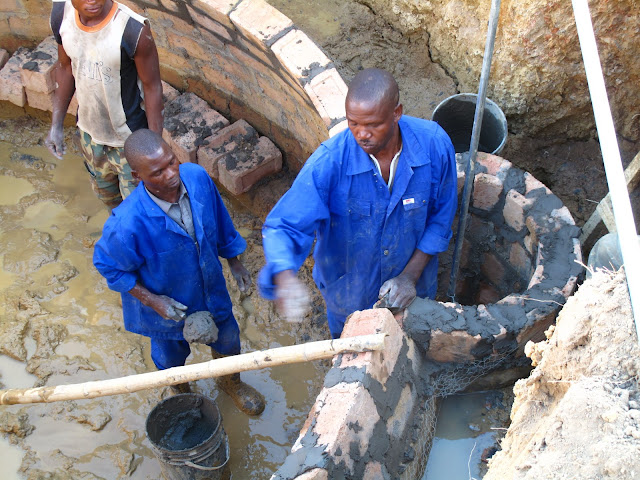
Excavating to build a biogas tank.
I say fun because our clients are THE BEST. Our clients live in rural areas that can often only be accessed by riding motorcycles through gorgeous scenery. They love having visitors and always find time in their busy lives to show you around and tell stories about how they used to walk three days to Nairobi or how they had to shoo elephants out of their gardens. And if you don’t stay for tea and lunch our clients will be offended. Let me know the next time you are in Kenya so I can bring you to meet some of our clients. Working with them is the best part of the job.
A biogas system with a nearly completed dome.
So what is biogas? It is very similar to natural gas. Biogas can be produced by anything that rots such as vegetable waste, farm waste, cow dung, pig dung and even human waste. We build a tank to hold the waste and collect the gas that is piped to our clients’ houses. Interestingly (to me), while few Americans know about biogas, nearly all Kenyans have heard of biogas before, have seen it on TV and want one built if only they knew who could construct one for them—which is where we come in.
Plastering the outside of a biogas digester. Gotta make it air-tight!
The magic that people can’t believe is that the dung from their cows which often goes to waste can produce fire. Really, some people think it is some kind of magic. The biogas can be used for cooking (just like a natural gas stove), lighting (see below), generating electricity, pumping water, running engines to chop animal fodder and heating water for showers. For our clients it is luxury. They say they really don’t know how they lived before they had biogas. It saves so much time, money and energy.
Field Manager Joseph Installs a Biogas Lamp. Blog Post
The biogas accessories (stove, lamp, generator, etc) are some of the most important parts of the biogas system. Without them, biogas is just a gas. With them; power. For now we are importing these accessories from China, but we are starting to develop biogas accessories made in Kenya.  It would create jobs here and help build the manufacturing capacity of Kenya. Making biogas accessories in Kenya will substantially reduce costs for our clients and bring biogas to more homes than would be possible otherwise.
Developing a Made In Kenya Biogas Lamp. The first of its kind! From Left: Graham, a grade school friend and Operations Director; John, metal workshop owner; me; Collins, executive assistant and Swahili tutor.
Now we are raising $8,000 through Launcht and the William James Foundation business plan competition to design, test and distribute the first batch of Made In Kenya biogas lamps and stoves. If you are interested in donating or know anyone who is interested in donating please share this link with them:

Biogas BBQ

Water Alchemy Ltd. installed a biodigester at the Nelson Environment Centre, New Zealand. The digester has been the topic of many Show & Tells', but this was it's first BBQ !! Using biogas created only by the input into the digester of cuttings from the garden.
I was not planning on making a video, so did not film accordingly.

KSB-Biogas

KSB-Biogas

The proper & useful ways of disposing your piggery waste- Biogas

The proper & useful ways of disposing your piggery waste- Biogas
biogas plant


Because of the continous increase in prices of basic commodities such as LPG i decided to make our own source of fuel out of waste, Yes it's from waste! we have a small backyard piggery & i used the manure in producing this fuel called "biogas" this is very efficient & FREE! I hope everyone will use this kind of technology it will help them to save money as well as to make our environment clean. To those who are living in cities & subdivisions im planning to build a biogas plant that uses leftover foods, biodegradable materials such as rotten vegetables & fruits that can be collected from our own kitchen & from the markets. My new biogas plant is located in Banay-banay San Vicente, Lipa City, Batangas, Philippines. My family started using it in cooking their meal. Thanks God I have successfully completed it before I leave for South Korea.

Toilet maker flush with success after bio-gas bike ride

Toilet maker flush with success after bio-gas bike ride

Biogas is one of many forms of alternative energies being promoted as the way of the future, but no one has yet done it in the style of Japanese toilet manufacturer, Toto. The company has created a stir with what it calls its Toilet Bike Neo, a motorcycle that runs on biogas and looks like a toilet on wheels. Ben Gruber reports.

GKVK campus to have biogas power plant

GKVK campus to have biogas power plant
Digester diagram


Here’s a bit of news that civic authorities and producers of large quantities of organic waste should sit up and take notice. The University of Agricultural Sciences (UAS) is set to inaugurate a biogas power generation plant at the GKVK campus. This is the first of its kind on any university campus in the country.
There are package plants that can handle as little as 50kg to 300kg. These can be assembled anywhere. All it requires is 20x20 sqft space, water and electricity. However, it is not viable to equip small plants for electricity generation, says KC Achappa, a general manager at the Mailhem Engineers company that is executing the project on the GKVK campus. “The generator engine costs Rs2 lakh to Rs3 lakh. It is not viable for smaller plants. You need at least one tonne of cowdung to extract power,” he said.
One tonne of cowdung can yield 40-50cubic metre biogas per day. Such a plant would cost Rs17lakh-Rs18lakh plus about Rs2.5 lakh for the engine. A tonne of food or other waste can give 70-80 cubic metre of biogas. If you go in for a biogas plant of 500kg of food waste, you can plan for power generation; you will get 40cubic metre of gas and can generate 60 units per day. The plant itself consumes only 6-7 units a day.Such an installation will cost Rs10-12 lakh, said Achappa.
The potential of such a facility is immense, especially for cities with huge amounts of organic waste. “Pune already has five plants of one tonne each. This is used for street lighting,” he added.
In the last 18 years, the company has set up 300 biogas plants all over India. “We have put up plants in Parliament and a five-tonne plant in the Hampi heritage centre,” he says.
While UAS now has a biogas plant, the city’s civic authority, which claims to handle over 3,500 tonnes of solid waste every day, is yet to make progress. The university plant will be inaugurated during the Rashtriya Krishi mela, which begins today.

Anaerobic Digesters and Biogas

 Anaerobic Digesters and Biogas

In a world almost completely dependent on fuel for many everyday luxuries of life, there is steady headway towards a more personalized solution to the fuel shortage problem in many parts of the world. Biogas is an alternative that allows people to produce their own fuel using waste. It also allows for a cleaner burn then wood making it a viable solution for developing countries that have excessive indoor air pollution.

Introduction

A constant hunt for alternatives to a world powered by unsustainable oil has yielded possible small and large scale solutions to the current issues in the industry. It also allows a way for developing countries to escape dependence on foreign infrastructure and imports that they do not have the means to pay for. One place this technology is taking root is in rural china, which still uses biomass such as wood and crop residue, as well as coal, for everyday needs. India is yet another country taking steps in this direction. There are individual projects pushing this technology, but they are largely academic primarily because this technology is still being spread. There are large-scale projects and companies that are using this technology, but the people using the technology are not generally buying kits or products; they are building their own. This is promising because in order for the fuel source to actually be taken advantage of, it has to be widely accessible to a wide variety of people. The actual digesters that create the biogas may be different in appearance, but they all tend to use the same general concepts.

History

This is, by no means, a new technology as is typical with many sustainable alternatives explored today. Possibly the earliest known usage of biogas was in the 10th century BC for heating bath water in Assyria (Harris). The first person known to show that decaying organic matter created flammable gas was Jan Baptita Van Helmont in the 17th century. Bombay, India has the first claim of a functioning digestion plant in 1895 by a leper colony. Biogas was even used by England as a source of fuel for street lamps in Exeter around 1895. We can only go off of documented accounts to get a comprehensive picture as to how biogas usage evolved, but what can be concluded is that it is and has been a viable fuel source for Centuries.

Context

Biogas is still an emerging technology for many countries around the world, but the two countries that have seemed to delve the deepest into this field are rural India and China. The Appropriate Rural Technologies Institute and Biotech appear to be major contributors to domestic fuel alternatives and waste usage in India. Many Chinese build their own systems but private industry is also there to lend a hand. Among them are Chongqing Wangliyuan Agricultureal Development Co. and Shenzhen Puxin Science & Technology Co. These companies not only sell digester parts and systems, they also sell a large variety of appliances that run off biogas. Another prominent group advocating a lot of this sort of technology and should be mentioned is The Global Alliance for Cookstoves. The goal of the alliance is to outfit 100 million homes by 2020 and they are partners with profit, non-profit, and public groups (including their biggest supporter: Shell).

The major reason in both countries for a switch to Biogas is indoor air pollution. Dung cakes used in India release toxins when they are burned to cook food (Tewari). This has lead to serious health problems including tuberculosis and lung cancer. According to the World Health Organization, “Burning traditional fuels indoors produces harmful smoke that contributes to an estimated 420,000 premature deaths each year in China.” (Peach). Women and children are most often affected by this plight and it leads to a death somewhere in the world every 20 seconds (WHO). The time spent cooking over a fire is most directly related to this statistic, which is why biogas should be considered for cook-stove use. There was debate as to whether the possible methane leaks would create even more problems with global warming, but after testing it was concluded that even with a few methane leaks anaerobic digesters, over a span of 20 years, would create up to 54 percent less warming then traditional fuels (Peach). The other issue that is true of all fuels is the fact that biogas is extremely flammable and is therefore a hazard if not used correctly. Social trends pushing the general population away from oil and towards independence on a personal level (as well as a public level) will spread biogas technology. Prices for current fuel options may also play a part in the shift.

Anaerobic digestion is the process leading to the creation of biogas. The general process starts by feeding organic wastes, and feces into the main chamber of the digester and allowing fermentation to take place (Spuhler). This is simply the change from non-soluble to soluble organic compounds. There is no oxygen in this process and the optimal temperature is 97 degrees Fahrenheit (Climatelab). Natural microbes aid in the breakdown and conversion of the material. The second step is acidification where the soluble organics become volatile fatty acids and carbon dioxide (Spuhler). They are then convert into acetate and hydrogen. The methane is formed last leaving a mixture of methane and carbon dioxide as the finished product. There are two different main types of digesters: dry or wet. The byproducts besides biogas include the water that went into the process as well as residual organic material that can fertilize crops. China tends to use a CFD or China Fixed Dome and India uses IFC or India Floating Cover (Climatelab). Maintenance cost is low, and the general cost is anywhere from 120- 600 dollars depending on the climate of the location. It is more expensive to build in a place like china because of the temperate climate. In general, this explanation applies to domestic units but holds true for other systems as well.

The gas can then be stored and used to fuel cook stoves. This solves a lot of the original issue because the fuel burns so much cleaner then wood or coal. The Global Alliance for Cookstoves reports that using biogas lowers emissions by 95 percent and cuts energy usage up to 70 percent. This is just one solution to the “1.9 million premature deaths annually, with women and young children the most affected (The Global Alliance for Cookstoves).


Analysis

China

Chongqing Wangliyuan Agricultureal Development Co. is a private company that sells to a great number of countries and sells a wide variety of products dealing with biogas. The Biogas Test Center of Agricultural Academy tests their products. Among their products they sell biogas digesters, enamel biogas anaerobic reactors, biogas appliances, fittings, generators, storage tanks, and more. They are located in Chongqing, China and employ engineers and chemists for the advancement of their product. They delve into environmental management, product design and macromolecule materials.


Shenzhen Puxin Science & Technology Co. is another private company who sells many of the same products as Chongqing Wangliyuan Agricultureal Development Co. and has many of the same goals. They also employ a similar staff with similar credentials. The goal is to find new energy that incorporates environmental protection. They are located in Gaungdong, China and have been up and running since 2001.

India

Appropriate Rural technologies Institute developed their domestic biogas plant in 2003. They are located in Maharashtra and are run by scientists and social workers. It is an academic group that started out with 9 original projects. Their products are not sold by them and are distributed instead by Samuchit Enviro Tech Pvt Ltd. Their goal is to raise people’s standards of living. They accept donations but there is no actually information on where the majority of their funding comes from that is easily accessible.

Biotech was established in 1994 and spreads awareness as well as training people to help others in various fields. Their focus is on renewable energy; development, and research. They are located in Kerala, India. There overall purpose appears to be to spread information; particularly there anaerobic digester systems.

Conclusions
Overall the options in India that I was able to find deal more with non-profit systems that share information for the greater good. All I could find out about the Chinese approach was through Private industry. All four groups I looked at wanted the same thing to some degree. It is relevant to look closely at both China and India because they are the prominent users of this technology. In this project I feel that most of the information is not actually recorded because so many people build there own digesters and do not look at the consumer world at all. The biggest problem is distribution because the companies that offer their products cannot offer them for free. If the impoverished cannot afford the consumer solution it makes sense that they would just build their own and bypass the middleman all together. This technology is extremely important and will continue to gain importance as time goes on, but it may be more of a cultural movement focused on the spread of the information rather then selling a product.


Works Cited

"Domestic Biogas Plant." Climatelab. MindTouch Enterprise,
2009. Web. 12 Apr 2011.
.

Harris, Paul. "A brief History of Biogas." Beginners Guide to
Biogas. The University of Adelaide, 04 Nov 2011. Web.
12 Apr 2011.
.

"Indoor air pollution and health." World Health Organization.
WHO, 2011. Web. 12 Apr 2011.
.

"Overview." Global Alliance For Cookstoves. Global Alliance
For Cookstoves, 2011. Web. 27 Feb 2011.
.

Peach, Sarah. "Greening China's Indoor Fuel Use." Chemical &
Engineering News. American Chemical Society, 07 Mar
2011. Web. 12 Apr 2011.
.

Spuhler, Dorothee. "Anaerobic Digestion (Organic Waste)."
Sustainable Sanitation and Water Management. SSWM,
2011. Web. 12 Apr 2011.
.

Tewari, Ritika. "Significance of Anaerobic Digestion in Rural
India." AltEnergy eMaqazine. LJB Management Inc., 2011.
Web. 12 Apr 2011.
.


Companies Cited:

http://cqwangliyuan.en.alibaba.com/

http://puxinbiogas.en.alibaba.com/productgrouplist-202675376/Biogas_home_appliances.html#products

http://www.arti-india.org/

http://biotech-india.org/Domestic_Biogas.aspx


Images Cited:

http://pubs.acs.org/cen/news/89/i11/8911scene.html

http://www.sswm.info/category/implementation-tools/wastewater-treatment/hardware/solid-waste/anaerobic-digestion-organic-

http://image.made-in-china.com/2f1j00FvRaNnurEycz/Biogas-Stove-JZZ-1A3-.jpg

http://image.made-in-china.com/2f1j00IvmEDchlAPqK/Biogas-Stove-Double-Burner.jpg

http://cleancookstoves.org/wp-content/uploads/2011/04/SNV_Building_viable_domestic_biogas_programmes.pdf


source: http://sustainablebydesign.wikispaces.com/Anaerobic+Digesters+and+Biogas

Making Chemicals from Biogas Instead of Burning It

 Making Chemicals from Biogas Instead of Burning It

generated by organic matter in landfill sites or from biomass are commonly burned to generate electricity. However, a Finnish team, writing in a forthcoming issue of the International Journal of Sustainable Economy, suggests that such biogas might be more usefully used as an alternative feedstock for the chemical industry. They explain that using biogas in this way would reduce our dependency on oil and gas-derived products and is commercially and technically viable.ouko Arvola of the University of Oulu and colleagues there and at Oulu University of Applied Sciences point out that environmental pressure has turned our focus to reducing carbon emissions by the employment of renewable energy sources instead of fossil fuels. Biomass can be readily converted to usable energy mostly in the form of methane through anaerobic fermentation, they point out. Rather than simply burning this biogas, the team suggests that at the local level it would be beneficial in terms of resources and pollution to utilise this valuable carbon source as an industrial feedstock. They have now examined the viability of such an approach to industrial sites in Finland and demonstrated, in theory at least, that this is a serious alternative to natural gas or oil-derived resources.
To initiate such a switch to biogas from landfill and other sources, there may have to be subsidies akin to those implemented in food production. However, as the price of raw fossil materials -- oil and gas -- continues to rise, biogas will become a more competitive alternative feedstock and government support could gradually be reduced.
"The use of biogas can be promoted by identifying existing industrial sites currently using fossil-based gas as raw material and by analysing whether they can utilise biogas," the team says. "By constructing biogas producing unit at industrial sites potentially enables development of other biogas applications. Building pipelines to other biogas users, or vehicle uses, are potential options," they add.

ADBA delivers action plan documents

ADBA delivers action plan documents


The Anaerobic Digestion and Biogas Association (ADBA) has published two key documents which were promised in the AD Strategy and Action Plan to support the industry. They are available on the association’s website.

The Due Diligence template, developed in association with WRAP, offers a simple way for developers to check they have provided all the information which investors need to carry out due diligence on projects. Banks and VCs financing AD, their advisers and ADBA’s Lawyers Working Group, which includes representatives from major law firms, were among those who helped ensure the document is comprehensive.

The template provides developers with overarching guidance on what investors would expect to see in a business plan, and gives investors a simple way to check where the information they need can be found. The template aims to help reduce the cost and complexity of due diligence and facilitate raising finance.

ADBA has also published a list of current financial schemes available to AD projects. Collating these into one accessible document gives developers a signpost to such schemes, and where they can find more details.

Charlotte Morton, Chief Executive of ADBA, said:

“We are delighted to announce the publication of both ADBA’s Due Diligence template and a comprehensive list of financial schemes available to the AD industry, two of the eleven industry actions ADBA were assigned in the AD Strategy and Action Plan.

“I would like to thank the many people who have contributed to these – particularly WRAP and Compass Renewables.

“Delivering these documents is part of the wider work ADBA is doing to develop the AD industry, both within and outside the actions agreed in the Action Plan.”

Key facts you need to know about anaerobic digestion and biogas

The AD industry has the potential to generate around 40TWh of energy, equivalent to 20% of the UK’s domestic gas demand
The AD industry has the potential to be worth £2-3bn in the UK alone and employ 35,000 people
Overseas potential is significant and the UK could be a world leader - with the right support now.
Anaerobic digestion (AD) is a natural process which converts organic matter such as household food and garden waste, farm slurry, waste from food processing plants and supermarkets, into biogas and biofertiliser.
Biogas (which is approximately 60% biomethane, 40% CO2) can be utilised to generate electricity and heat, or, upgraded to bio-methane, as a transport fuel or fed directly into the UK’s gas grids
According to the Carbon Trust the generation of bio-methane would save twice as much carbon dioxide as producing electricity by 2020
AD is the only renewable that can be scaled up fast enough to enable the UK to reach its 2020 renewable energy target
AD significantly improves Britain’s energy security - we will soon be importing over 70% of our gas
AD reduces greenhouse gas emissions by treating organic wastes which would otherwise emit methane (landfill, slurries) and reducing our use of energy intensive commercial fertilisers and fossil fuels
AD preserves critical natural resources such as Nitrates and Phosphorus. Phosphorous is a finite resource for which there is no known alternative. It is critical for plant growth and world resources are already running out. Nitrates are one of the key components of fertilisers.
Unlike other renewables, biomethane is generated constantly and can be stored in the gas grid, and biomethane is one of the few renewable fuels for Heavy Goods Vehicles (HGVs) which cannot run on electricity

Five facts you need to know about ADBA

ADBA stands for The Anaerobic Digestion and Biogas Association
The Anaerobic Digestion and Biogas Association was founded in September 2009
Since its launch ADBA has acquired over 250 members, including AD plant operators, suppliers, local authorities, farmers, utility and energy companies such as British Gas and Ecotricity, supermarkets such as Waitrose and Morrisons, fleet operators such as Coca Cola and Howard Tenens
ADBA’s chairman is Lord Redesdale, former Liberal Democrat energy spokesman
ADBA’s aim is to help enable or facilitate the development of a mature AD industry in the UK and to represent all businesses involved in the anaerobic digestion and biogas industries, to remove the barriers they face and to support its members to grow their businesses and the industry to help UK plc meet its renewable energy, climate change and landfill targets, as well as the preservation of critical natural resources.

Share

Twitter Delicious Facebook Digg Stumbleupon Favorites More