:::: MENU ::::
Showing posts with label Download PDF Book. Show all posts
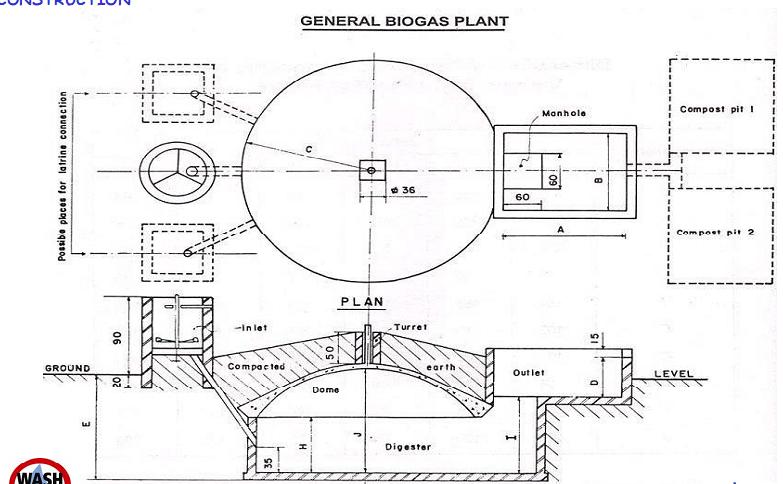
Biogas Plant Construction Manual  Fixed-dome Digester:  4 to 20 Cubic Meters 

Afghan-Biogas-Construction

Forward
In July 2010 United States Forces Afghanistan (USFOR-A) were requested by General David H.Petraeus, Commander International Security and Assistance Force (COMISAF) to investigate the feasibility of biogas technology in Afghanistan. The leading purpose for the rural application of biogas is two-fold: alternative to burning manure and other organic material in the home, and returning nutrientrich fertilizer to the land. Research show these attributes benefit human health and the environment.USFOR-A Joint Engineer Directorate worked closely with United States Agency for International Development (USAID), Islamic Republic of Afghanistan Ministry of Energy and Water – Renewable Energy Department (Director Amir Mohammad Alamzai), Ministry of Rural Rehabilitation and Development, and Ministry of Agriculture, Irrigation and Livestock to investigate existing biogas technology in Afghanistan, identify competent contractors designing and constructing biogas digesters, and identify facilities and institutions with the potential to incorporate biogas technology. Director Alamzai provided USFOR-A contacts at the non-profit organization Agency for Rehabilitation & Energy Conservation in Afghanistan (AREA). AREA had demonstrated experience and knowledge in the design, construction and operation of biogas plants in several provinces of Afghanistan, specifically the fix-dome biogas digester made popular in Asia. USFOR-A contracted AREA to design, construct and operate an 8-cubic meter biogas plant at the Renewable Energy Department, Kabul in the winter and spring of 2010-2011. The biogas plant was completed in six weeks and fed dairy cow manure and water.The manual is based on both the Gobar biogas plant and the performance by AREA during the construction of the biogas plant in Kabul. We sincerely appreciate the support and direction from General Petraeus, Major General Timothy McHale (USFOR-A Deputy Commander for Support), Brigadier General Buckler (Director JENG), Brigadier General Mark Yenter (Director JENG), Brigadier General Mark Martins (Rule of Law Field Force), Colonel Louis Dell‟Orco, Lieutenant Colonels Dallas Olson, Butch Welch and Robert Tucker, PhD (JENG), Mr. Abdul Rasool Wardak and the folks with US Agency for International Development. We also appreciate the skill and work of Staff Sergeant Jeffrey Hart for turning rough sketches into professional Engineer designs and the financial process support of Captain Moses Wearing to ensure funding of this project through the Commander‟s Emergency Rsponse Program. We learned much about the practical design and construction of the biogas plant from Engineer Khail Shah and Engineer Arif Ulla Azimi of AREA and have shared these lessons in this manual. We especially thank Director Alamzai for his support and leadership to guide and direct the project at his facility in Kabul and of course thank the citizens of the United States of America for granting us the resources to accomplish this and many other projects to improve the security and legitimacy of the Government of the Islamic Republic of
Afghanistan.

Download: 

2011-04-27 Afghan Biogas Construction Manual FINAL


www.scribd.com/.../2011-04-27-Afghan-Biogas-Construction-Manual-...
The manual is based on both the Gobar biogas plant and the performance ..... This manual includes design and construction material quantities for the Gobar biogas plant models of 4, 6, 8, 10, 15 and 20 cubic meters capacity. Design and size of a plant other than mentioned above is feasible and a skilled ...
[PDF]  Or  

Biogas Plant Construction Manual


https://ronna-afghan.harmonieweb.org/.../2011-04-27_Afghan_Biogas_...
File Format: PDF/Adobe Acrobat - Quick View
27 Apr 2011 – operate an 8-cubic meter biogas plant at the Renewable Energy Department, ..... This manual includes design and construction material quantities for the Gobar biogas plant models of 4, 6, 8, 10, 15 and 20 cubic meters capacity. ... mentioned above is feasible and a skilled engineer should be consulted for ...

869 KB
[PDF] Biogas Download
484 KB
[PDF] Biogas Download
88 KB
[PDF] biogas Download
2.8 M
[PDF] BIOGAS Download
1.2 M
[PDF] Biogas Download
3.3 M
[PDF] biogas Download
1.9 M
[PDF] Biogas und Co. Biogas und Co. Download
2.3 M
[PDF] BIOGAS Download
22 KB
[PDF] Biogas Göttingen GmbH & Co. KG Download
207 KB
[PDF] Biogas Download
32 KB
[PDF] BIOGAS Download
22 KB
[PDF] BIOGAS (CHP) BASED CO-GENERATION SYSTEMS As Biogas is available at Download
545 KB
[PDF] Enhanced Biogas Production Using Co-Substrates in Anaerobic Download
490 KB
[PDF] Biogas Download
85 KB
[PDF] Biogas Download
357 KB
[PDF] Biogas Download
564 KB
[PDF] biogas Download
853 KB
[PDF] REI 20 BIOGAS Generator Sets Download
721 KB
[PDF] Biogas Generator - Build Your Own Download
829 KB
[PDF] CO and Generator Safety Download

[PDF] GENERATOR Download
8.7 M
[PDF] Zukunft: Biogas Zukunft: Biogas Download
54 KB
[PDF] Taizhou Kaihua Diesel Generator Sets Co.,Ltd. Download
1.8 M
[PDF] GENERATOR Download
899 KB
[PDF] GENERATOR Download
1.9 M
[PDF] GENERATOR Download
40 KB
[PDF] Generator for Noisy Reference Data with Co-occurrence Relationships Download
1.6 M
[PDF] PDF 1.7 MB - Stranded Biogas Decision Tool for Fuel Cell Co-Production Download
733 KB
[PDF] Download paper - Modeling and co-simulation of Wind generator Download
1.3 M
[PDF] NATURAL HERITAGE AND WATER ASSESSMENT ASHBRIDGES BAY BIOGAS CO Download
1.2 M
[PDF] Co-Generation - West Generator Services, Inc. Download
14 KB
[PDF] biogas Download
5.7 M
[PDF] KIPOR POWER PRODUCTS CO., LTD. GENERATOR SHOP MANUAL Download
3.4 M
[PDF] User's manual for Generator Control Unit EGCON CO., LTD Download
901 KB
[PDF] biogas Download
6.3 M
[PDF] ML506 DSP Hardware Co-Simulation with Xilinx System Generator for Download
1.0 M
[PDF] Biogas Download
109 KB
[PDF] Biogas Download
1.9 M
[PDF] BIOGAS Download
580 KB
[PDF] Biogas Download
1.5 M
[PDF] Biogas Opportunities Download
53 KB
[PDF] SULFUR IN BIOGAS Download
233 KB
[PDF] Biogas 905 Download
847 KB
[PDF] Generator Download
316 KB
[PDF] Generator Download
202 KB
[PDF] Generator Download
294 KB
[PDF] Generator Download
593 KB
[PDF] Model: 7.5EKD-Low CO 60 Hz 6EFKD-Low CO 50 Hz Marine Generator Set Download
3.3 M
[PDF] GENERATOR Download
2.0 M
[PDF] Generator Download
94 KB
[PDF] GENERATOR Download
828 KB
[PDF] GENERATOR Download
1.2 M
[PDF] Generator Download
901 KB
[PDF] The Generator Download
80 KB
[PDF] Generator Download
996 KB
[PDF] Generator Download
35 KB
[PDF] Generator Download
61 KB
[PDF] GENERATOR Download
1.6 M
[PDF] Generator Download
7.2 M
[PDF] GENERATOR Download
The Design and Theory of a Basic Anaerobic Digester


With environmental issues such as the greenhouse effect and correct waste disposal methods gaining much attention throughout the community, the concept of controlled anaerobic digestion is perhaps a much overlooked example of a way to reduce green house gas emissions and provide a better waste disposal method for organic waste.

Introduction 

Controlled anaerobic digestion is by no means a radical or new concept. Large scale industrial digesters and small domestic digesters are in operation in many places around the world. The purpose of all these digesters is to produce combustible biogas which can be burned to provide energy for a whole range of uses. Here in Australia, there is quite a bit of ideological interest in anaerobic digestion and biogas production, particularly from intensive farmers, but there are not many examples of digesters in operation. These farmers are interested in this topic primarily as an alternative energy source (biogas), and secondly, as part of an efficient effluent waste disposal system for the farm. Somehow there seems to be a problem in finding ways to put controlled anaerobic digestion into practice on the average Australian farm. There is almost a small library of information from all over the world on this topic, but this information doesn't seem to be reaching the average intensive farmer with some interest in this topic. Why isn't this concept being utilized more? There could be a number of possible reasons for this including the capital cost of setting up an anaerobic digester project, a lack of working models and / or a lack of a source of ideas to base individual projects on, i.e. - trouble shooting and project development at a technical 'on farm' level. The purpose of this project was to develop a small scale working prototype possibly suited to operate on the average farm. The focus of this project was the production of usable (combustible) biogas. This project is definitely not supposed to be revolutionary or radically new, but rather to be a starting point for further research and development in this area.  The purpose of this report is not to provide a method for the fabrication of the project produced (although a basic materials list will be provided). Rather, this report will aim to identify key aspects of the design, concentrating on their function and the theory behind their function. Therefore, the aim of this report is to provide the reader with a
basic explanation of the mechanics of a small, continuous flow anaerobic digester.

Download   PDF The Design and Theory of a Basic Anaerobic Digester

Climate Friendly Farming Topics, Anaerobic Digestion (Biogas) 

Small-Scale Biogas Technology


Biogas technology has been used globally for decades, with primary applications for large-scale, high-tech commercial systems in Europe (and limited penetration in the US) and small-scale, low-tech “house-hold” scale systems in Asia. The potential for application of biogas technology on small-scale farms in the US is great for providing alternative means for managing on-farm organic wastes (manure, on-farm food processing) and providing a clean, renewable source of energy for on-farm applications (thermal energy for water heating, food processing, etc.). Making biogas technology a viable option for small farms requires the development of reliable, effective biogas reactors that can be readily fabricated and maintained by farmers. With support from the USDA Western Sustainable Agriculture Research & Education Program (Western SARE), CSANR developed a project to explore options for developing improved biogas technology for applications in small-farm settings in the US. Resources developed in this project are available on this site.

Project Resources and Publications

Advanced Biogas Plant Design
Detailed CAD drawings for improved version of pilot biogas plant developed at WSU.
Advanced small-scale anaerobic digester design tailored for household user living in cold climate
WSU Invention Disclosure.
A Procedure to Estimate Proximate Analysis of Mixed Organic Wastes
Journal of Water Environment Research 81:4.
Biomass Inventory Technology and Economics Assessment
Wei Liao, Craig Frear and Shulin Chen, June 2007. This project compiled a literature search for biomass chemical characterization and conducted supplemental laboratory study of forty two feedstocks for 33 parameters such as dry matter, COD, carbohydrates, lipids, elemental and mineral matter, and standard properties such as protein, fiber, pH, etc. A follow-on report will group similar feedstocks, assess potential energy conversion technologies and conduct an economic analysis of feedstock collection and energy production.
Producing Energy and Fertilizer from Organic Municipal Solid Waste - Project Deliverable #1
Usama Zaher, Dae-Yeol Cheong, Binxin Wu, and Shulin Chen, June 2007. A literature review of current digester technologies formed the framework for designing a bench scale study of a high solids anaerobic digestion (HSAD) system. The study shows that significant improvements in methane production can be attained while decreasing capital costs for facilities.  A new digester design is proposed that will optimize methane from organic food and green waste digestion, while recovering nutrients from the digestate. 
Household Biogas Digester: An Underutilized Potential
A presentation on applications of small-scale biogas plants in India.
Biomass Inventory and Bioenergy Assessment
Craig Frear, Bingcheng Zhao, Guobin Fu, Michael Richardson, Shulin Chen, and Mark Fuchs, December 2005. A biomass inventory and bioenergy assessment of forty five organic resource types across Washington was completed, producing this report and a database with GIS maps (http://www.pacificbiomass.org). Annual production of over 16.4 million tons of underutilized bone dry biomass was found, capable of producing (either by combustion or anaerobic digestion) over 15.5 billion kWh of electrical energy.
Smale-Scale Biogas Plant Enterprise Assessment Tool
A worksheet to facilitate preliminary planning for a biogas plant on a small farm.

Images

Images of small-scale biogas plant.  The pilot plants developed for this project were fabricated from steel to facilitate mobility and durability as demonstration units.   Actual biogas plants could be fabricated from a number of different materials.
biogas4
biogas3
biogas2
biogas1

Source: http://csanr.wsu.edu/pages/Small-Scale_Biogas_Technology
 Anaerobic Digestion for Developing Countries with Cold Climates 


Utilizing solar heat to address technical challenges and facilitating dissemination through the use of carbon finance


Summary

A large proportion of the rural poor in developing countries have no access to a secure source of energy. The  rural poor  in developing  countries  rely  primarily on  traditional  biomasses,  such  as wood  and  charcoal.  The  reliance  on  traditional  biomasses  and  solid  fuels  result  in  substantial human, social and environmental cost. To  tackle  these costs a switch  to a clean  fuel  is required. One  of  the  solutions  is  anaerobic digestion  (AD)  of  manure  or  other  biodegradable matter  to produce a clean fuel: biogas.
The principle of AD has been known for 3-4 centuries and in 1920 the first digester was designed  for  house  on  site  biogas  production.  A  digester  is  a  technology which  converts  the commonly found wastes in rural areas, manures, in a controlled anaerobic environment to biogas and  an  excellent  fertilizer.   Biogas  is  a  clean,  convenient,  versatile  and  environmentally  benign fuel which  does  not  pollute  the  indoor  air.  Furthermore,  a  biogas  plant  has  several  additional benefits, such as replacing bought or collected wood (time or revenue savings), provision of light by biogas lamps, empowerment of women by relieving them of the drudgeries of  traditional fuel gathering. A toilet is in most cases attached to a digester which improves sanitation, a significant virtue  since  the majority  of  the  poor  lack  access  to  sanitation. The  effluent  from  the  digester, digestate,  has  a  high  fertilizer  value  comparable  to  chemical  fertilizers.  Digestate  is  also  an excellent fish feed and can enhance fish yields. The adoption of biogas digesters has considerable spillovers to the local, national and even to a global level. For instance, at local level, employment opportunities, skills development and reduced pressure on the forest. At  a national level, it leads to  less health costs, more employment, and potential  foreign exchange earnings and  at a global level: greenhouse gas emission mitigation. Consequently, the cumulative effects of these benefits alleviate poverty and contribute to achieve the Millennium Development Goals.
Download
 Anaerobic Digestion for Developing Countries with Cold Climates http://www.wecf.eu/download/2009/EricBuysman-AnearobicDigestionforDevelopingCountrieswithColdClimates-June2009-MasterThesis-Final.pdf

INTRODUCTION TO CONSTRUCTION OF HYBRID BIO-DIGESTER – VACVINA

 INTRODUCTION TO CONSTRUCTION OF HYBRID BIO-DIGESTER – VACVINA

The objective of this book is to provide trainees with the process at each step as well as
echnical concept in building Vacvina bio-digester with its significant modification as follows  

  • Study possible digester construction site on basis of geographical and soil condition;

  •   Technical design in building and fixing underground tanks;

  •   How to prepare and install equipments for Vacvina plant; and

  •   Other factors to operate and maintain Vacvina tanks.

 Table of contents
 
1. How to Calculate Required Digester Volume ....................................................................................... 2
2. Preparation of Construction Materials and Appliances......................................................................... 3
3. Construction and Material Installation .................................................................................................. 4
3.1. Digester construction.......................................................................................................................................4
3.1.1. Digging.....................................................................................................................................................4
a. Construction site selection..........................................................................................................................4
b. Digging.......................................................................................................................................................4
3.2.2. Making digester foundation......................................................................................................................4
3.1.3. Bricklaying of the walls ...........................................................................................................................5
3.1.4. Mortar and cement liquid plastering.........................................................................................................5
3.1.5. Making digester concrete .........................................................................................................................6
a. How to assemble mold and install supporters of the mold to construct digester concrete..........................7
b. How to determine and make the technical hole during construction of top concrete.................................7
c. Preparing and casting iron rods ..................................................................................................................8
d. How to mix cement to construct top concrete 200B...................................................................................8
e. Concrete thickness......................................................................................................................................8
f. Concrete vibration and maintenance...........................................................................................................8
g. Making technical hole cover ......................................................................................................................9
3.1.6. Making concrete of worktop for cooking.................................................................................................9
3.2. Installation of appliances...............................................................................................................................10
3.2.1. Installation of inlets (siphon)..................................................................................................................10
3.2.2. Installation of outlet system ...................................................................................................................11
3.2.3. Installation of bottle safety valve ...........................................................................................................12
3.2.4. Installation of gas reservoir ....................................................................................................................12
a. How to install gas reservoir ......................................................................................................................13
b. Technique in tying gas reservoir ..............................................................................................................13

c. How to tie gas reservoir with plastic tube at its end .................................................................................13
d. Selection of place for gas reservoir ..........................................................................................................13
e. Operation..................................................................................................................................................13
3.2.5. Installation of biogas burners .................................................................................................................14
3.3. Filling soil around the digester ......................................................................................................................14
4. Attention for Operation and Maintenance of Biodigester – Vacvina Model....................................... 15
4.1. Feeding raw materials into digester...............................................................................................................15
4.1.1. First feeding of manure ..........................................................................................................................15
4.1.2. Daily feeding of manure.........................................................................................................................15
4.2. Operation of biodigester................................................................................................................................15
4.2.1. When reservoir is full of gas ..................................................................................................................15
4.2.2. When gas burners in operation...............................................................................................................16
4.2.3. When whole system in use .....................................................................................................................16
4.2.4. Warning of chemical into digester .........................................................................................................16
5. Appendix ............................................................................................................................................. 17
5.1. Practical exercise in calculation of total volume of a digester, construction materials and investment cost.17
5.1.1. Ouch Veasna family (Takeo province)...................................................................................................17
5.1.2. Thap Chaney (Kampong Speu province) ...............................................................................................19
5.2. Detail designs of biodigester system.............................................................................................................22
 
 
Download PDF Book CONSTRUCTION OF HYBRID BIOGAS DIGESTER

Download Biogas PDF from FAO Food and Agriculture Organization


  1. BIOGAS PRODUCTION FROM MIXTURES OF CATTLE SLURRY AND PRESSED SUGAR ...


    File Format: PDF/Adobe Acrobat - Quick View
    by B Pound -
    Trop Anim Prod 1981 6:1. 11. 1. Technical Cooperation Officer, Overseas Development Administration, London. 2. Consultant to to the Project DOM 77/002 ...
    www.fao.org/ag/AGa/AGAP/FRG/tap61/61_11.pdf
    ►
  2. [PDF]

    Small-Scale Biogas Scheme for Poverty Scale Biogas Scheme for ...


    File Format: PDF/Adobe Acrobat - Quick View
    Technical Consultation on. Sustainable Small. Sustainable Small-Scale Livelihood. Scale Livelihood-Oriented Bio. Oriented Bio-energy. Initiatives ...
    www.fao.org/bioenergy/26330-0724f10bd49389d3f7f3167a9dcfd8f10.pdf
  3. [PDF]

    Addendum B3 Biogas


    File Format: PDF/Adobe Acrobat - Quick View
    Common Fund for Commodities. PROJECT CFC/FIGHF/07. PRODUCT AND MARKET DEVELOPMENT OF. SISAL AND HENEQUEN. Project Completion Report ...
    www.fao.org/es/esc/common/ecg/330/.../Addendum_B3_Biogas.pdf - 
  4. [PDF]

    THE PRODUCTION OF BIOGAS FROM CATTLE SLURRY, THE EFFECTS OF ...


    File Format: PDF/Adobe Acrobat - Quick View
    by A Santana -130. Trop Anim Prod 1980: 5:2. Paper first presented at the 5th Annual Meeting of the Dominican Centre for Livestock. 1. Research with Sugar Cane, ...
    www.fao.org/ag/aga/agap/frg/tap52/5_2_5.PDF
  5. [PDF]

    THE EFFECT OF RETENTION TIME ON BIOGAS PRODUCTION FROM SLURRY ...


    File Format: PDF/Adobe Acrobat - Quick View
    by A Boodoo -Trop Anim Prod 1977 4:1. 21. This work was supported in part by funds provided by the UNDP/FAO project MAR/75/004. 1. FAO Consultant to MAR/15/004; ...
    www.fao.org/ag/aga/agap/frg/tap41/4_1_3.pdf
Biogas from Waste and Renewable Resources: An Introduction

Description:

Written as a practical introduction to biogas plant design and operation, this book fills a huge gap
by presenting a systematic guide to this emerging technology -- information otherwise only
available in poorly intelligible reports by US governmental and other official agencies. The author
draws on teaching material from a university course as well as a wide variety of industrial biogas
projects he has been involved with, thus combining didactical skill with real-life examples.
Alongside biological and technical aspects of biogas generation, this timely work also looks at safety
and legal aspects as well as environmental considerations.

Authors bio:
Dieter Deublein is Professor for Applied Biotechnology at the Munich Unversity of Applied Sciences
(Germany). A graduate from the Technical University of Munich, he has more than two decades of
professional experience in the large scale processing of natural resources, mainly from food and
feed. Since 1992 he is a member of the Faculty of the Munich University of Applied Sciences, where
he has established a strong teaching record in biotechnology and environmental management. He
is a leading scientific authority on the technological aspects of biogas production, both in small-
scale and large-scale operations.

Contents:

Introduction
- Development of world energy consumption
- Current global use and potential of biogas
Biogas
- Main biogas components
- Side components: ammonia, hydrogen sulfide
- Main biogas substrates
Biochemistry and Microbiology
- Biogas evolving reactions
- Biogas producing bacteria
- Bioreactors
Safety and Legal Aspects
- Legal regulations
- Fire and explosion hazard
- Microbial safety
- Feasability studies
Biogas Plant Design
- Preprocessing of raw materials
- Bioreactors for simple fermentation
- Bioreactors for dry raw materials
- Bioreactors for low energy raw materials
- Bioreactors for mixed raw materials
Biogas Use
- Collection and storage
- Gas processing
- Generation of electricity and heat
- Biogas as supplement to natural gas
- Biogas as automotive fuel
Environmental Considerations
- Solid waste
- Wastewater
Appendices
- General scheme and business model of a biogas plant
- List of suppliers.

Read online

Download

Alternate Download Link
 
Biogas in Cities – A New Trend?


Anaerobic Digestion of Kitchen and Market Waste in Developing Countries So far, several million conventional biogas plants, using predominantly animal manure as feedstock,have been successfully installed in rural areas of developing countries. However, can anaerobic digestion also be a suitable technology to treat organic household waste in urban and peri-urban areas to alleviate the solid waste crisis in cities of the developing world? Yvonne Vögeli, Chris Zurbrügg

In many cities of developing countries, the most serious environmental and health problems are related to inadequate solid waste management (SWM). Progressing urbanisation and rapid population growth
lead to increasing amounts of waste, thereby also increasing pressure on local authorities responsible for the provision of safe and reliable public services.Municipal Solid Waste (MSW) in developing countries is rich in organic material (upto 70 %). However, if this organic fractionis not managed adequately, it causes nuisance for urban dwellers and pollutes theenvironment due to its easily biodegradable nature. Unreliable collection leadsto smelly dumps in neighbourhoods and attracts animals, such as rodents, the typical transmitters of diseases. Lack of treatment or non-engineered and unsafe disposal causes soil, surface water and
groundwater pollution through leachate, and uncontrolled methane emissions contribute to global warming. Consequently, particular attention should be given to the organic fraction of municipal solid waste.
Some treatment options for biodegradable waste, such as aerobic composting or direct animal feeding have been identified in practice and are more or less well-recognised as proven solutions in certain contexts. Nevertheless, there is still scope for improvement by increasing the value and further potential benefits of the treatment steps and generated products. Aside from using worms or larvae to digest the waste
(as described in another article of this Sandec News issue), anaerobic digestion (AD) or biomethanation of organic solid waste is likely to be a promising treatment option. Under anaerobic conditions, bacteria break down the organic matter and produce biogas. This mixture of CO2 and methane (CH 4) can be used as an energy source for cooking, lighting or even to generate electricity, thereby replacing other fuels.

 Read more...

Or 

Download
BIOGAS TECHNOLOGY: A TRAINING MANUAL FOR EXTENSION

source: http://www.fao.org/docrep/008/ae897e/ae897e00.htm


TABLE OF CONTENTS
PREFACE
TABLE OF TABLES
TABLE OF FIGURES
TABLE OF CHARTS
TABLE OF ANNEXES
ACRONYMS AND ABBREVIATIONS
RELEVANT UNITS AND CONVERSION FACTORS
INTRODUCTION TO MANUAL
SESSION ONE : SYSTEM APPROACH TO BIOGAS TECHNOLOGY
1.1 Introduction
1.2 Components of a Biogas System
1.2.1 Biogas
1 2.2 Methanogenic Bacteria or methanogens
1.2.3 Biodigester
1.2.4. Inputs and their Characteristics
1.2.5 Digestion
1.2.6 Slurry
1.2.7 Use of Biogas
1.3 Implications of Biogas System
1.4 Session Plan
1.5 Review Questions
1.6 References
1.7 Further Reading Materials
SESSION TWO : RELEVANCE OF BIOGAS TECHNOLOGY TO NEPAL
2.1 Introduction
2.2 Energy Situation in Nepal
2.2.1 Tradition Sources of Energy
2.2.2 Commercial Sources of Energy
2.2.3 Sources of Alternative Energy
2.3 Biogas in Other Countries
2.4 Biogas Potential in Nepal
2.5 Uses of Biogas
2.5.1 Cooking
2.5.2 Lighting
2.5.3 Refrigeration
2.5.4 Biogas-fueled Engines
2.5.5 Electricity Generation
2.6 Biogas and Agriculture
2.7 Biogas and Forests
2.8 Biogas and Women
2.9 Health and Sanitation
2.10 Municipal Waste
2.11 Economy and the Employment
2.12 Session Plan
2.13 Review Questions
2.14 References
2.15 Further Reading Materials

Recent Posts

Related Posts Plugin for WordPress, Blogger...

Followers

Featured Posts